I have been writing lists since I was in primary school. Whether it was a list of all the movies I'd watch or the crazy to-do list of fun things to do this summer, or list all the things to-do before dying. I started keeping this list years before I had anywhere to put it. Names scribbled in the backs of notebooks, screenshots I never filed, Instagram posts saved and website links on a word document. Here are the first four to make it out. One makes me want to dance under a full moon, one makes me want to study better, one makes me want to steal, and one has brought me to tears more than once. I can think of no better reasons to put an artist on a list.
Grace Cross
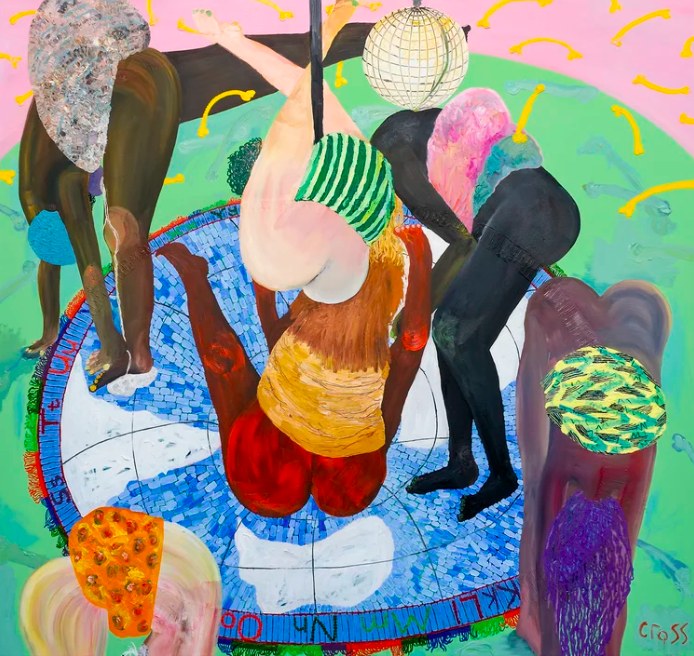
Cross calls herself a material painter, and the term is exact. Her canvases behave like textiles, stitched and woven as much as painted, threading symbols of motherhood, land and belief through compositions that read like excavation sites. She speaks of performative archaeology and she means it. A childhood spent across Zimbabwe, South Africa, Kenya, Greece, India and the United States produced an artist who treats inheritance itself as her medium. Cosmologies, maternal bloodlines and the red thread of fate are sewn directly into the surface. There is nothing sentimental in it. The work is loud, dense and unafraid of beauty, and it stirs something older than looking. Every time I stand in front of one I want to go dance under a full moon. With Motherhood Paradox now at the Iziko South African National Gallery, an institution is finally giving her subject the wall space it demands.
Jongjin Park
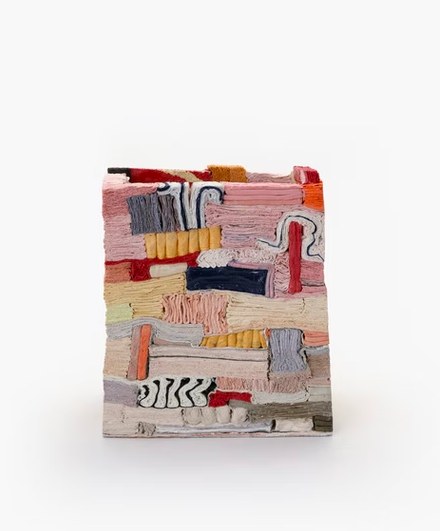
Park's sculptures announce themselves as one thing and turn out to be another. What reads as a slumping stack of fabric, or a cross section of sedimentary rock, is porcelain. Hundreds and sometimes thousands of sheets of ordinary paper are dipped in coloured slip, layered, compressed and fired until the paper burns away and only its ghost remains, every crease preserved in ceramic. He began in the Joseon Moon jar tradition and, through a decade of research he formalised in a PhD, pushed the medium somewhere it had never been. The craft world noticed. This year the Loewe Foundation Craft Prize, the most serious award in the field, went to his Strata of Illusion. His is the work that humbles me most. Every encounter with it sends me back to my own craft, wanting to learn it properly. Mastery this complete is an instruction.
Some work argues its way into you. His just moves in.
Claudiu Ciobanu
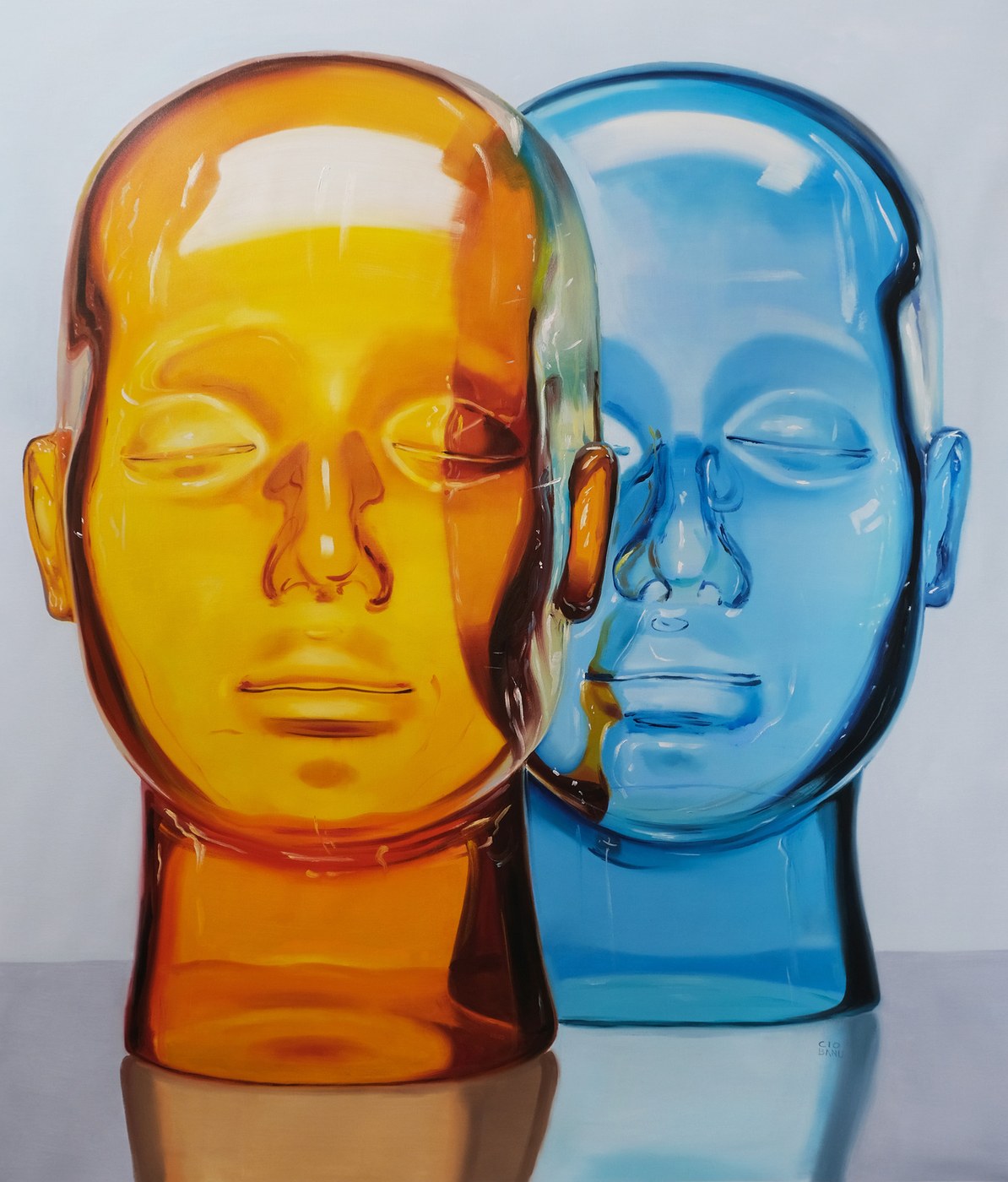
Ciobanu has spent two decades painting from Iași, the old cultural capital of Romanian Moldavia, and staying. No relocation to Berlin or Bucharest, no rebrand. The work has travelled instead, to Venice, Vienna and Washington, and recently to a research residency on body politics at Haus der Kulturen der Welt in Berlin, which fed the Utopian Body paintings shown last autumn. His subjects are memory, time and the body under pressure from technology. Memento vivere, he titled his Vienna exhibition, turning the old instruction to remember death into an instruction to remember living. I will confess the least critical response I have to any artist here. His paintings trigger pure covetousness. I do not want to interpret them. I want to take one off the wall and walk out. Some work argues its way into you. His just moves in.
Flora Yukhnovich
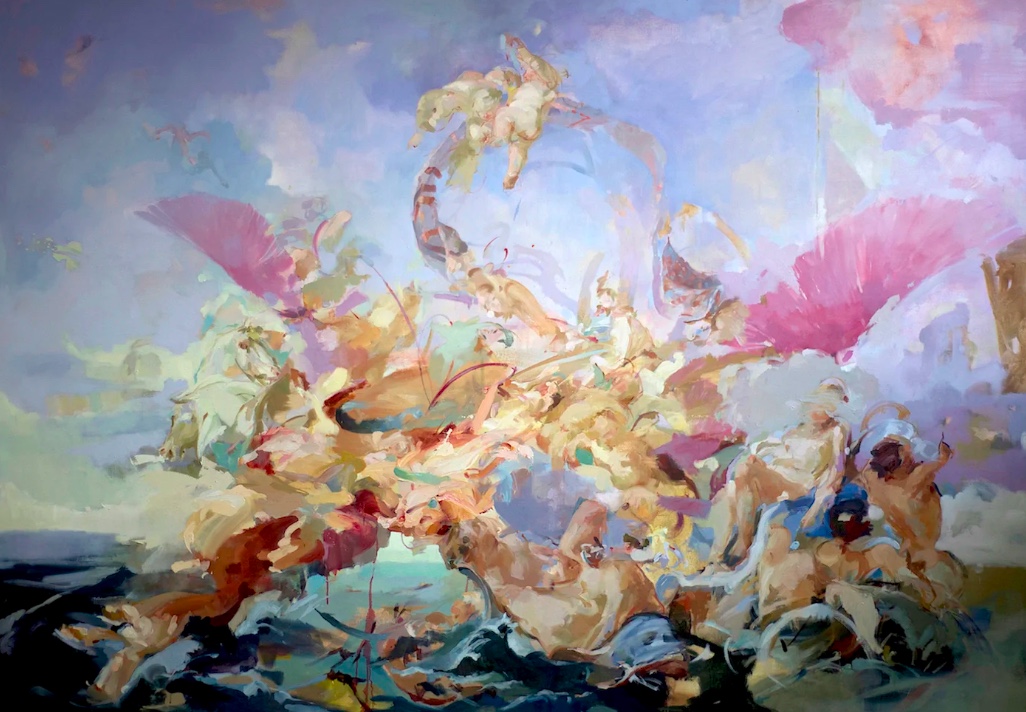
Yukhnovich needs no introduction, which is exactly why she earns one here. It would be easy to file her under market phenomenon, since the auction results made sure of that, and miss what the paintings actually do. She takes the Rococo, the most dismissed style in European art history, ornamental, feminine, frivolous, and dissolves it into abstraction until the dismissal itself becomes the subject. Tiepolo's skies and Boucher's silks survive as sensation rather than image. Pleasure is taken seriously as a critical position. The frenzy around her prices has often drowned out the intelligence of the work, so let me state my own response plainly. Her paintings bring me to tears. Every time. No other painter of my generation does that to me. On this list she is not the headline. She is the proof that noticing has nothing to do with discovering.