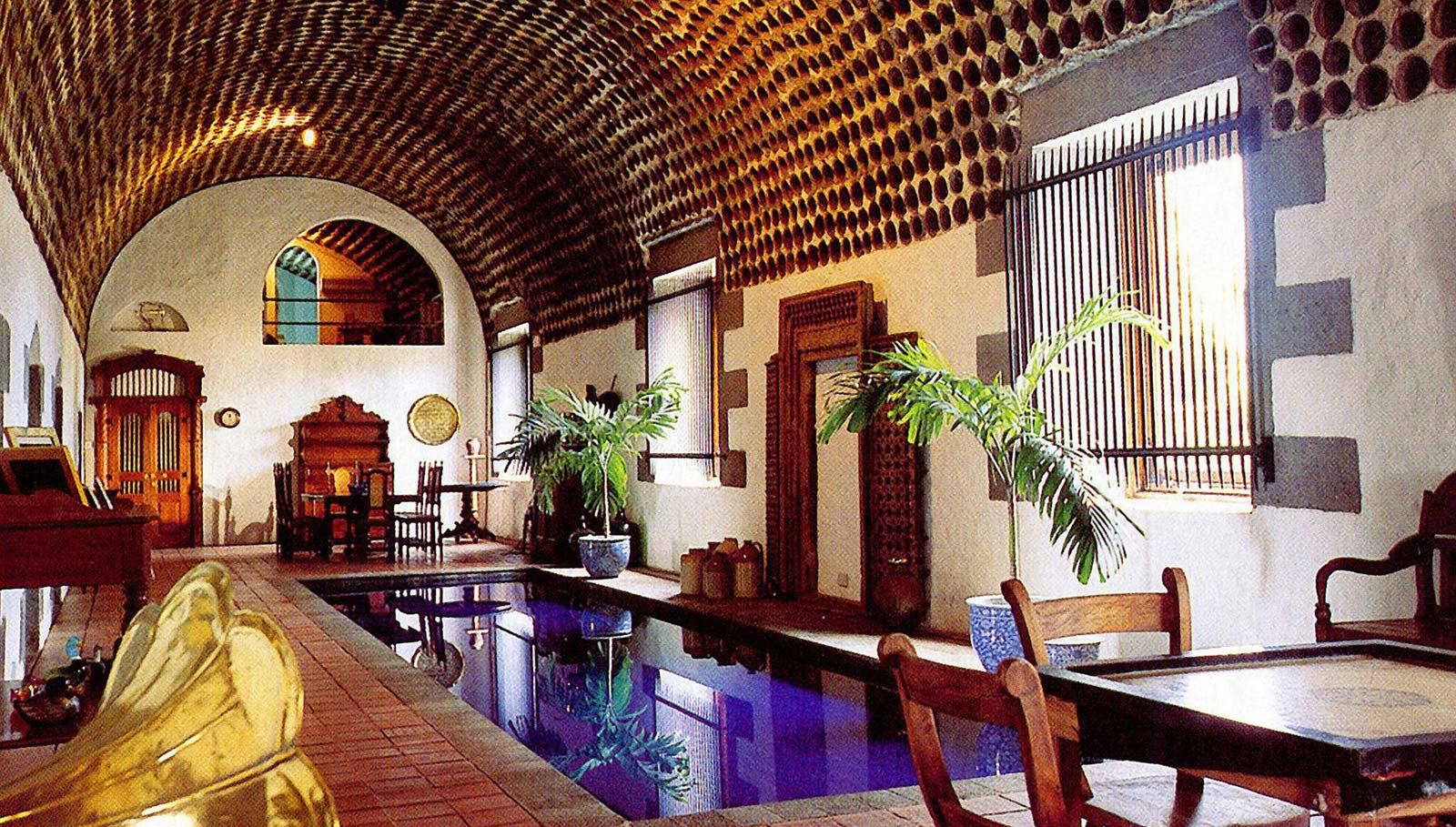
It is only later in life that I discovered what a city with a vibrant art scene meant. Even when I first travelled to Paris, that feeling, that sentiment, didn't translate for me the way it does for what I feel for the Cape Town or Johannesburg art scene. Growing up on the island of Mauritius, I only remember a couple of spaces that truly ignited the feeling that I wanted to enter the art world. One was an old sugar mill called the Galerie du Moulin Cassé, directly translating to Gallery of the Broken Mill, with its 20,000 terracotta pots perched along the vaulted arcs of the ceiling.
The space was built in 1820, and by the time I visited in the contemporary era, the gallery boasted paintings by the trailblazing Mauritian artist and philosopher Malcolm de Chazal, to whom I had already been introduced through a print in my parents' bedroom, which to this day sits in the exact same spot it did over twenty years ago. In the corner of one of the galerie's rooms sat a pool whose purpose, at the time, I could not figure out. The sugar mill closed its doors in 1880, apparently due to a lack of water, and was abandoned for 86 years before a new owner restored it into a home. I must assume the pool was built by its modern owner to offer some relief from the hot and humid Mauritian summers. The space was cool and lovely, in a literal sense, thanks to the clay pots creating insulation. Vaulted ceilings were a common feature of Mauritian colonial architecture, used specifically to keep buildings cool and dry in the humid subtropical climate. I remember the tropical plants adorning the space, the stone walls, the terracotta floors and the paintings of de Chazal creating the perfectly idyllic tropical art gallery.
I am aware that nostalgia is an unreliable narrator, but after doing as much research as possible on the subject, the photos still ignite in me this instinct and this tenderness that bring me right back home, home to Mauritius, but also home to my initial discovery that I belonged in this space, filled with magic, creation, history and beauty.
Hiding in the mediocrity
The Galerie du Moulin Cassé really was, at the time, an isolated pocket of culture, although simultaneously part of something larger. It reflected the uniqueness, the idiosyncratic nature and the craftsmanship of Mauritius. This was the first art gallery I ever went to, and to this day, my favourite art gallery on the island. Of course, some well established museums and institutions had already been running for years, such as the Blue Penny Museum, the Mauritius Natural History Museum and the National Art Gallery, but with poor representation of any contemporary artist who didn't fit the mould of your typical watercolour or acrylic seascape, hibiscus flower or mangrove still life, with the odd African portrait rocking the touristic corners.
Apart from the occasional disruptor, the contemporary and modern artists we still reference on the island, I cannot remember any spaces, venues, festivals, little pop-ups or anything of the sort that would promote or showcase an artist of some “superior degree” or academic background who was not your casual Sunday painter. But trust me, they did exist. They were there, hiding in the mediocrity, behind the weak exhibition programmes of the National Art Gallery and in the quiet corners of a broken mill.
The question was never whether Mauritius had artists. It was why so few people, inside or outside the island, ever got to see them.
A major breakthrough
Now, in 2026, the island has undergone a major breakthrough in the cultural landscape, which I believe was ignited by pivotal events like Porlwi by Light in 2015. It was the first time contemporary art was presented to a mass Mauritian audience as something belonging to them, in their streets, for free. This festival, whose first edition I remember participating in, was exciting, different and beautiful. A spectacular representation of the broad spectrum of Mauritian artists, from dancers to painters, designers, musicians, filmmakers and sculptors, started by a young Mauritian couple.
Then, in 2019, came the Mauritius International Art Fair, anchoring itself as a “pioneering platform positioning Mauritius as a premier art and cultural destination”, although I cannot find any curated exhibitions or programmes, artist lists or showcased artworks. Everything in the public record about MIAF points to an event that is far better at talking about the market than generating one. The language across all three editions is almost entirely aspirational, all “positioning”, “roadmap” and “ecosystem”, with no published sales data, no named collector acquisitions, no gallery partnerships announced, and no evidence of sustained collector relationships developed. However, the fact alone of an international art fair establishing itself in Mauritius is fairly conclusive evidence of the island's aspiration to build the idea of an art scene.
Several contemporary art galleries, creative spaces and curatorial platforms have opened in the country, mostly in luxury hotels where the price of each work is marked up tenfold for tourists, and then some. The ones worth visiting have been opened by young creatives, the younger generation of entrepreneurs actively working towards making Mauritius a larger cultural ecosystem rather than just a space for tourists to hide in their all-inclusive resorts and never leave until they have to catch their plane back home. These include IMAAYA Art Gallery, ArtMe, pARTage, The Third Dot, and even the Caudan Arts Centre, which doesn't fall into the same category of young entrepreneurship. There was another space called the House of Digital Art, a project opened in 2023 by the same people behind Porlwi by Light, which appears to have permanently closed already. Housed in a heritage building and internationally connected, it lasted roughly two seasons before retreating to a touring model, which tells me the gap between the vision and its audience closed it. Another wonderful space was the ICAIO, the Institute of Contemporary Art Indian Ocean, which exhibited some important contemporary artists. It was an institution opened by the accomplished Salim Currimjee, and it unfortunately closed its doors a few years ago.
Rich in talent, thin in infrastructure
As for the galleries themselves, these are the spaces where I trust the curators most, should you wish to start investing in Mauritian art, with artists such as Djuneid Dulloo, Kim Yip Tong, Gaël Froget, Krishna Luchoomun, Salim Currimjee, Cendrine Bolaram, Patrick Ricco and Evan Sohum. Yet even these creatives cannot afford to be full-time artists living off their sales.
The most honest assessment comes from Krishna Luchoomun in 2024: “To the question of whether an artist can make a living from their art in Mauritius in 2024, I would categorically say no. Artists spend much more than they earn. And institutions and corporations buy only by connection.” He also noted the indignity of being asked to pay exhibition fees at the very institution where he has lectured for over twenty years. That is where the Mauritian art scene stands in 2026: rich in talent, thin in infrastructure, and still waiting for the institutional and corporate support that its artists have long since earned.
What I have come to realise is that most of these galleries come and go, with a few surviving through connections, interior designers or private funding. But ultimately, they end up closing. What seems to work best is touring exhibitions and pop-ups, in restaurants, offices or beautiful abandoned factories.
A question of education
In my honest opinion, it really is just a question of education, which leads to a larger audience. Art in Mauritius isn't what art is in Cape Town: trendy. Cape Town's art scene has become so large, so great, so hip, that it has almost slipped into a trend of its own. A First Thursday walk with a glass of wine, an exhibition opening in a new or established happening space in town, or the well known Cape Town Art Fair, running annually. In Mauritius, the trend for most youth has unfortunately pivoted, from having nothing modern on the island a couple of decades ago to shopping centres opening left, right and centre, leaving the galleries and museums empty even on days when entry is free. I know this for a fact. The whole island once held a free entrance weekend, when all the monuments and sites of Mauritius opened their doors to all Mauritians. I spent that entire day going from museum to museum, the Postal Museum, the Slavery Museum, the Aapravasi Ghat UNESCO World Heritage Site, the Blue Penny, the Citadel, the Natural History Museum, and saw close to no one. After a long, humid and sweaty day, I stopped at the nearest shopping centre, and it was bustling.
And let me tell you, from the experience of having grown up in Mauritius and watched the evolution of where people gravitate on a weekend: it is not to a pop-up exhibition, an art gallery or a museum. It is most definitely to the shopping centre, where art has disappeared behind the latest franchise conglomerates destroying the artisans of the island. This is why the Mauritian art scene is so idiosyncratic. It is trying to survive, trying to shine through the reflection of the short-term relief offered by consumerist conglomerates. It is the eclectic and peculiar character of the country's art scene, merging phenomenal talent with a platform that isn't large enough for anything but the disappearance of localism and its true relevance.